

We continue our series of materials on OEM traffic across regions worldwide. In this article, we turn our focus to...

26 March, 2026

The evolution of CGI in games reflects how the industry’s capabilities and gamers’ expectations have evolved over time. Vectors, sprites, polygonal models, motion capture, and ray tracing—step by step, artists and developers have worked to impress players and create truly immersive experiences. In this article, we’ll explore what the earliest experiments looked like.
Do you remember your first games? We started with “Tamagotchi” and “Tetris,” with its simple shapes and basic visuals, and then moved on to fully realized 3D games. Computer graphics in gaming have come a long way—from pixels to full photorealism. Today, these are no longer flat worlds, but carefully crafted digital universes with precise physics, geometry, and lighting. So, when did the journey of CGI in games actually begin?
It’s no secret that before the advent of home computers, entertainment meant arcade machines. Game developers used vector graphics instead of pixels: points on a coordinate system were connected with lines to form shapes and objects. The games looked like animated blueprints or frames from the sci-fi films of that time. A striking example of vector graphics creating the illusion of 3D was Atari’s Battlezone (1980).

Players looked through a periscope, seeing a barren landscape and angular tanks drawn with glowing vector lines on the screen. By today’s standards, it may seem extremely minimalist and primitive. However, in the early 1980s, it was considered a breakthrough—a first step into 3D space that left players breathless.
The development of computer graphics in games was largely defined by sprites—small pixel blocks used to represent characters, objects, and interface elements. The level of detail and color palette was minimal, but this didn’t limit the creation of games like Donkey Kong (1980) and Pac-Man (1981). Characters consisted of just a few dozen pixels. In Pac-Man, technical limitations meant the main character was simply a yellow circle that ate objects, while in Donkey Kong—there was Jumpman (later Mario) and a giant gorilla.

Creating game graphics came with technical challenges: memory was measured in kilobytes, and every pixel counted. Artists had to get creative, reusing colors, simplifying shapes, and often relying on flickering sprite animations. It wasn’t until the late 1980s that 16-bit consoles appeared. The Sega Genesis and SNES expanded color palettes and improved image resolution. This marked what many consider the golden age of game development, giving us classics like Sonic, Super Mario World, and F-Zero.
The mid-1990s marked a turning point in the evolution of pixel-based graphics. The shift from 2D to 3D models allowed for more vivid characters with volume, depth, and angles. Game developers began exploring polygons—small triangles used to build three-dimensional shapes. In addition, to make 3D graphics look realistic, programmers and CGI artists had to tackle more fundamental challenges:
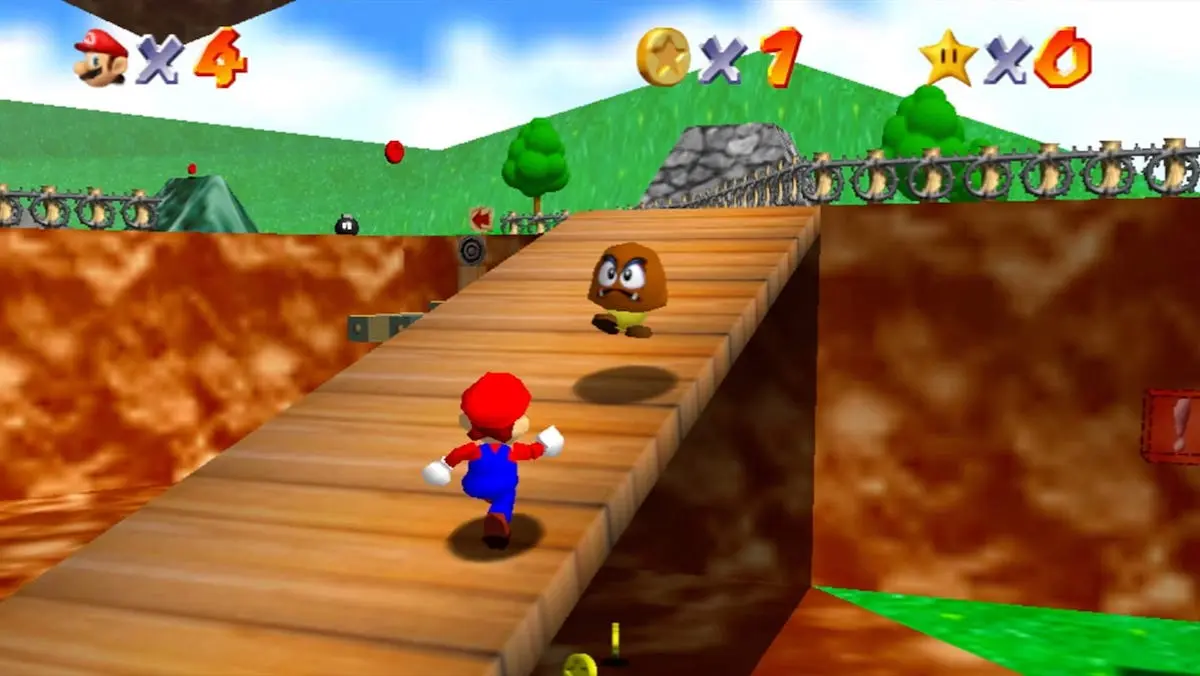
In 1996, Nintendo announced the release of Super Mario 64 for the N64 console. Many were skeptical about such changes, wondering how players would control a character in three-dimensional space and judge distances. Shigeru Miyamoto’s team designed the joystick to control walking speed and jump height. In addition, they “tamed” the camera: it followed Mario and could be zoomed in and out.
While Nintendo was teaching players to master the joystick, Core Design introduced a heroine made entirely of polygons. Lara Croft from Tomb Raider became a true star in CGI games. The world saw realistic character proportions, abandoned tombs, and ancient traps. Lara moved, ran, flipped, and fired dual pistols, making millions of players forget that her arms and legs were just a collection of textured triangles. She came to life in the imagination of players, proving that the graphics had done their job. As we know, the game later inspired films starring Angelina Jolie.

The phenomenon of 3D gaming in the mid-1990s was Final Fantasy VII for the PlayStation. The three-dimensional gameplay was combined with pre-rendered CGI videos. During cutscenes, the screen displayed highly detailed character faces, Cloud’s realistic hair, and Aeris’s tears. This striking contrast evoked strong emotions and captured players’ imaginations.

The early 2000s expanded the technological and technical possibilities of video game development. With the release of the PS2, Xbox, and GameCube, the world saw more complex computer graphics gradually approaching realism. A key change was the evolution of polygons and an increase in their number. 3D characters were no longer angular and gained more detail, while their movements became noticeably more natural.
Major changes also occurred in lighting techniques. Games began using shaders to control color, light, shadows, reflections, and transparency. Thanks to these, scenes appeared dynamic and realistic. For example, in Doom 3, flashlight lighting became a key gameplay element, creating a tense atmosphere and affecting spatial perception. In Half-Life 2, artists paid close attention to detail, achieving realistic faces with expressive emotions. CGI reached a new level of simulation and physics.

Shortly after, games began adopting the language of cinema. The story became part of the experience rather than just a background element. CGI cutscenes played a key role in this, setting a new standard for quality. Studios like Blur Studio and Digic Pictures created cinematic videos with high levels of detail, enhancing the drama and bringing games closer to full-fledged films.
Read more about the CGI creation process here.
The late 2000s saw the release of new computer programs that improved game graphics in terms of physics, animation, and scale. Objects in scenes were no longer static backgrounds—they responded to the player’s actions. Moreover, in the early 2010s, texture quality increased, adding more detail, realism, and immersion into virtual environments.
As mentioned earlier, the gaming industry drew inspiration from cinema. Motion capture technology, successful in films like The Lord of the Rings and Avatar, found its way into video games. A prime example is The Last of Us, where the characters’ emotions are conveyed through subtle facial expressions and movements, making them feel alive. Notably, The Last of Us Part II won two major awards—the Golden Joystick Awards and The Game Awards 2020. Animation, game design, and sound were outstanding, and fans praised the lifelike realism of the scenes.

At that time, games like Grand Theft Auto V and The Elder Scrolls V: Skyrim set a new standard. Players experienced vibrant, dynamic worlds where every detail enhanced the sense of presence.

The evolution of CGI, combined with player feedback, pushed artists toward photorealism. A key development was the introduction of ray tracing technology. Ray tracing simulates the behavior of light with maximum accuracy. Reflections, light refraction, soft shadows, and global illumination in game scenes are calculated based on physics, not imitation. Of course, creating photorealistic visuals requires more powerful PCs—but what wouldn’t you do for high-quality CGI?
Modern gamers are hard to impress, as almost every 3D game—especially on PlayStation—features vivid, high-quality CGI graphics with reflections, lighting effects, and lifelike facial expressions and movements. Nevertheless, we’ve compiled a list of the 10 best CGI games based on worldwide sales.
| 3D Game Title | Copies Sold | CGI Quality | Release Year |
| Grand Theft Auto V | 225+ million | Photorealism, lighting, animations, and open world set an industry standard | 2013 |
| Red Dead Redemption 2 | 82+ million | Highly detailed world, complex scene physics, behavioral animations, and lighting | 2018 |
| The Witcher 3: Wild Hunt | 60+ million | Deeply detailed characters and environments, realistic cutscenes | 2015 |
| Cyberpunk 2077 | 35+ million | Neon lights, reflections, RTX, dense urban environments; benchmark for ray tracing | 2020 |
| Hogwarts Legacy | 40+ million | Highly detailed world, advanced lighting, and magical effects | 2023 |
| Mario Kart 8 / Deluxe | 79+ million | High detail, polished visual effects | 2014 |
| PUBG: Battlegrounds | 75+ million | Average textures, simplified graphics | 2017 |
| Human: Fall Flat | 55+ million | Intentionally simple, “polygonal,” and cartoonish; focus on environment rather than realism | 2016 |
| Animal Crossing: New Horizons | 49+ million | Benchmark for cozy style, detailed textures, good lighting, and charming character animation | 2020 |
| Uncharted 4: A Thief’s End | 18+ million | Cinematic approach | 2016 |
Our CGI production studio creates visual worlds that captivate from the very first frame. We work at the intersection of technology and art to deliver high-quality computer graphics for our clients. Games, advertising, films, show content, e-commerce, automobiles, and entertainment—we produce CGI for any industry. For collaboration inquiries, contact us at cgi@acquisition.mobi.
We continue our series of materials on OEM traffic across regions worldwide. In this article, we turn our focus to...

Our international mobile app marketing company has been recognized by MobileAppDaily in four categories. This industry recognition increases our market...