
The smartphone market in Southeast Asia (SEA) is highly diverse. User preferences, market shares, and brand growth rates vary significantly...

28 July, 2026

We continue our series of materials on OEM traffic across regions worldwide. In this article, we turn our focus to Eastern Europe—a market characterized by significant heterogeneity and a diverse range of mobile ecosystems.
*In this series of articles, the division of Europe into Eastern and Western regions is conventional. We do not include Belarus, Russia, or Moldova in Eastern Europe. These countries are covered in our CIS overview.
Eastern Europe, when examined through the lens of smartphone OEM traffic, breaks down into three macro-regions: Central-Eastern Europe, the Baltics, and the Balkans. Each of these exhibits a distinct demand structure and market dynamics. Some countries attract vendors through stability and purchasing power. Others draw interest with high volumes and a low barrier to entry. In this overview, we examine how smartphone shares are distributed across these macro-regions based on user activity.
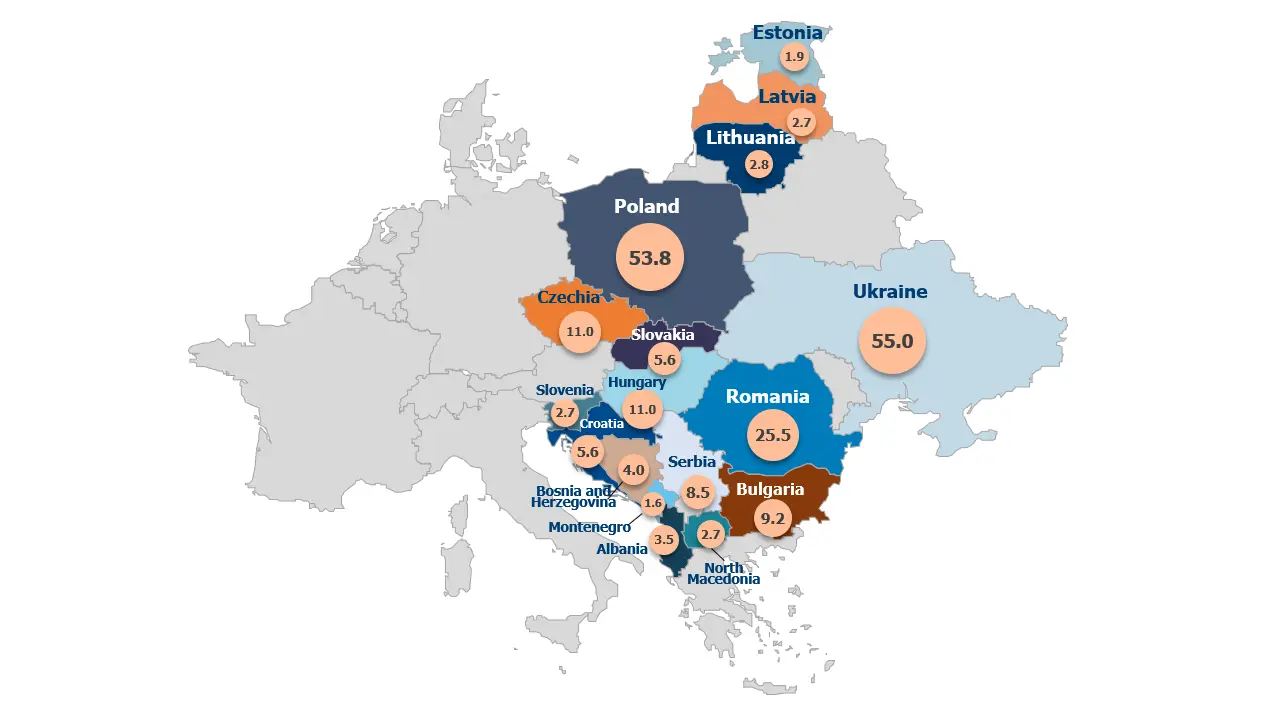
In our overview, Central-Eastern Europe comprises eight countries: Poland, the Czech Republic, Hungary, Slovakia, Slovenia, Ukraine, Romania, and Croatia. In terms of mobile cellular subscribers, Poland and Ukraine lead the region. Compared to 2024, Poland recorded an increase of 842,000 subscribers (+1.6%). Ukraine experienced a decline of 1.4 million (-2.5%).
Android devices dominate the macro-region. Their average share of internet traffic for January–June 2026 stands at 70%. The highest figures were recorded in Hungary (73%) and Croatia (72%). Unlike iOS, Android devices support in-app and built-in advertising. That makes the macro-region particularly attractive for OEM advertisers.
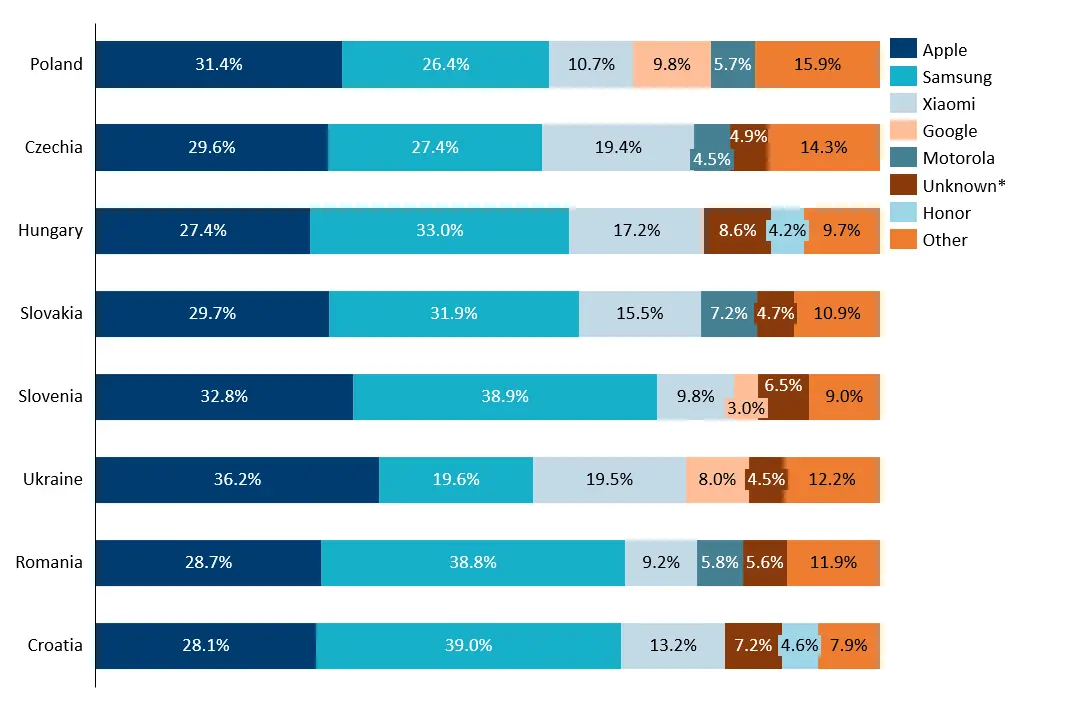
Within the macro-region, user activity is distributed primarily among three brands: Apple, Samsung, and Xiaomi. In the majority of countries, Samsung leads (5 of 8). Particularly high shares were recorded in Croatia (39.0%), Slovenia (38.9%), and Romania (38.8%). Apple dominates in Ukraine (36.2%). But in Poland and the Czech Republic, its share slightly outperforms Samsung. Notably, Ukraine and the Czech Republic have the highest Xiaomi shares among all countries in the region—19.5% and 19.4%, respectively—indicating the Chinese brand’s strong position in these markets. The Unknown share across the region remains low (4.5–8.6%). It reflects high-quality device identification and market transparency.
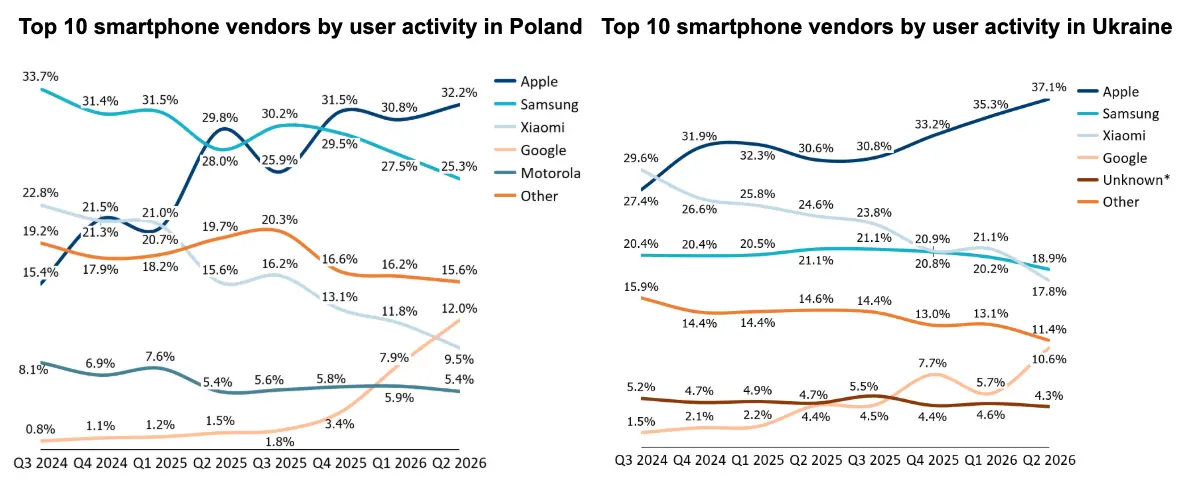
In the largest countries of the macro-region—Poland and Ukraine—Apple’s share has been on the rise over the past two years. In Poland, Apple and Samsung are locked in a battle for the lead. Despite Samsung’s weakening position in recent quarters, the brand still maintains a significant market share. Samsung’s position in Ukraine remains more stable, with little change observed over the last two years. Users in Poland react more strongly to new model releases.
Xiaomi’s share is declining in both countries, while Google is gaining traction. This is particularly noticeable in Poland. Since late 2025, brand loyalty has grown rapidly following the launch of the Pixel 10 model. Users have praised the improved software and device stability, which meet everyday needs.
The Baltic countries—Estonia, Latvia, and Lithuania—are relatively small markets in terms of mobile cellular subscribers. As of the end of 2025, Latvia had 2.7 million subscribers, Lithuania had 2.8 million, and Estonia had 1.9 million. Compared to 2024, Latvia and Estonia recorded growth in their subscriber bases—by 11,000 (+0.4%) and 918 (+0.05%), respectively—while Lithuania experienced a decline of 316,000 (-8.1%).
The countries are highly similar in terms of mobile traffic structure. As in Central-Eastern Europe, Android leads the way. Its average share in 2026 stands at 63%, which is lower than in the first macro-region.
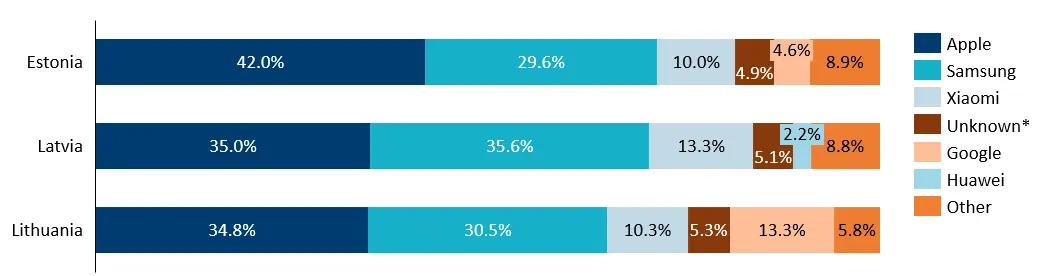
In the Baltics, leadership is split between Apple and Samsung in 2026. Samsung holds the top position in Latvia with a 35.6% share. In Estonia and Lithuania, Apple leads with shares of 42.0% and 34.8%, respectively. Notably, in Lithuania, the gap between Apple and Samsung is minimal. Google demonstrates a strong showing in Lithuania at 13.3%, setting the country apart from the rest. The brand ranks in the TOP 5 in Estonia (4.6%). But in Latvia it is replaced by Huawei with a 2.2% share. The share of unidentified devices is among the lowest in Eastern Europe (4.9–5.3%). It reflects a high level of market transparency.
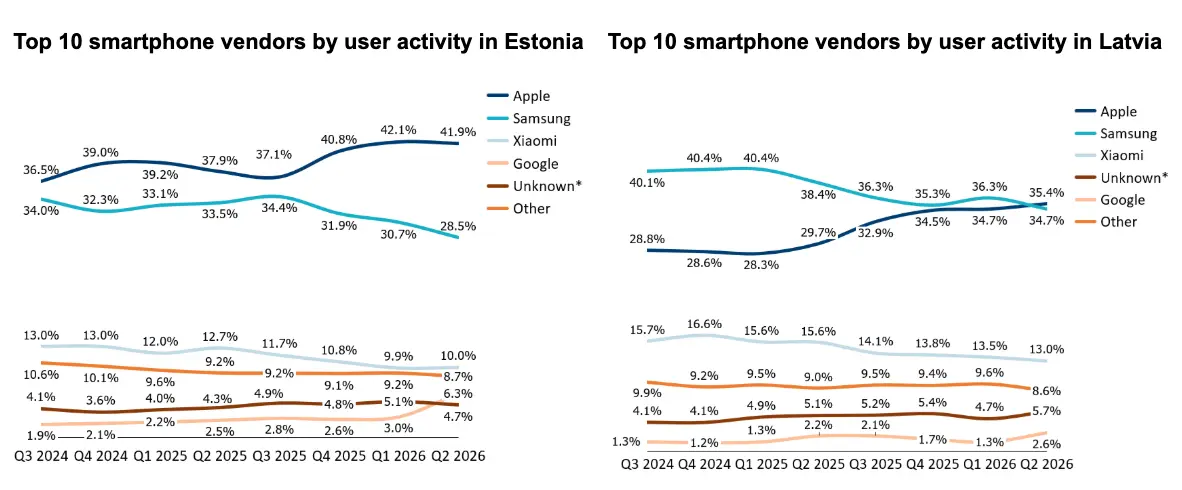
In terms of dynamics over the past two years, Estonia and Latvia have witnessed a battle between Samsung and Apple for the lead. The regions reflect the global trend of Apple’s growth in connection with the launch of the iPhone 17. Demand for other brands remains relatively stable. In Estonia, a notable increase in interest in Google smartphones can be observed in the first half of 2026.
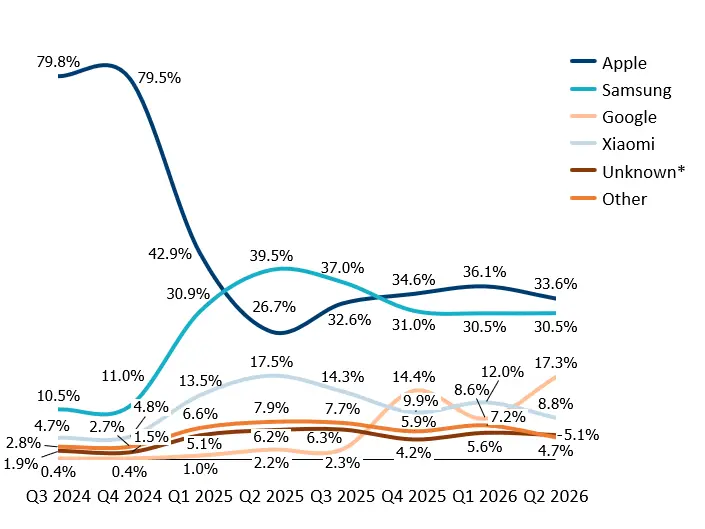
The sharp decline in Apple’s share in Lithuania—from 80% to 37% over the course of a year (2024–2025)—appears to be a statistical anomaly rather than a reflection of real market changes. Most likely, the shift is related to updates in Statcounter’s device identification algorithms, as evidenced by the synchronized growth of other categories. However, the overarching trend toward the strengthening of Android brands in the region remains evident. Particular attention should be paid to Google. Demand for the brand has been growing at a rapid pace over the past year.
We include six countries in the Balkans: Serbia, Bulgaria, Bosnia and Herzegovina, Montenegro, Albania, and North Macedonia. The largest markets in terms of mobile cellular subscribers as of the end of 2025 are Bulgaria and Serbia. However, both countries recorded a decline in their subscriber bases compared to 2024. Bulgaria down by 107,000 (-1.2%) and Serbia by 215,000 (-2.5%).
The average share of Android devices in the macro-region is relatively high, standing at 67% in 2026. This figure is pulled down by Albania. There the iOS share is significantly higher compared to the other countries in the region (53%).
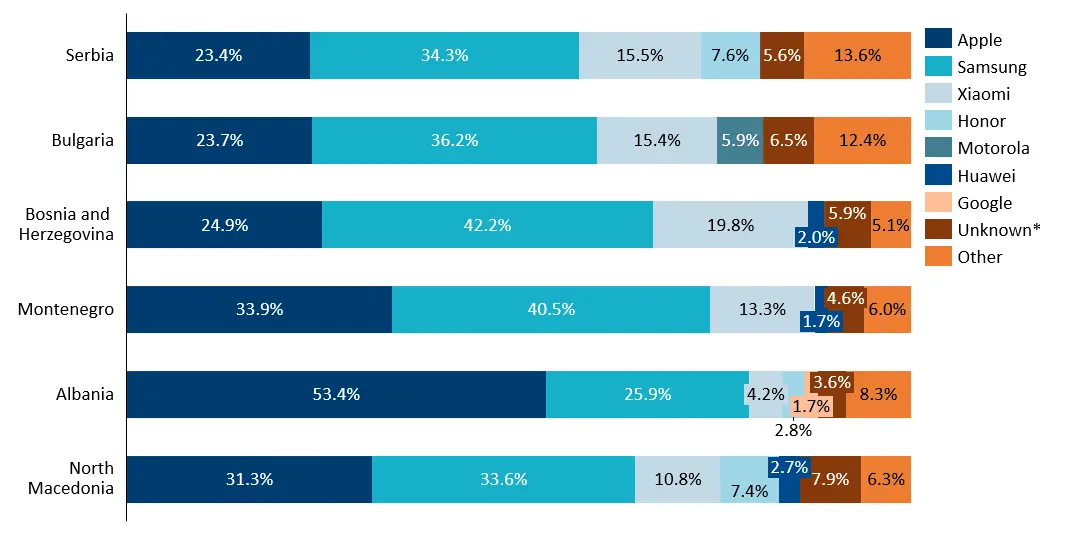
In the Balkans, Samsung leads in almost all countries (5 out of 6) in 2026. In Montenegro and Bosnia and Herzegovina, its share is particularly high—40.5% and 42.2%, respectively. Apple’s share in Serbia (23.4%) and Bulgaria (23.7%) is the lowest in all of Eastern Europe. Albania stands out from the other countries with its high loyalty to Apple. This can be explained by the phenomenon of status consumption, where owning the brand signals a high social standing. Bosnia and Herzegovina distinguishes itself with a high share of Xiaomi (19.8%). Bulgaria stands out for having Motorola in the TOP 5 (5.9%). Serbs and Macedonians actively use Honor, with the brand ranking in the TOP 5 in both countries.
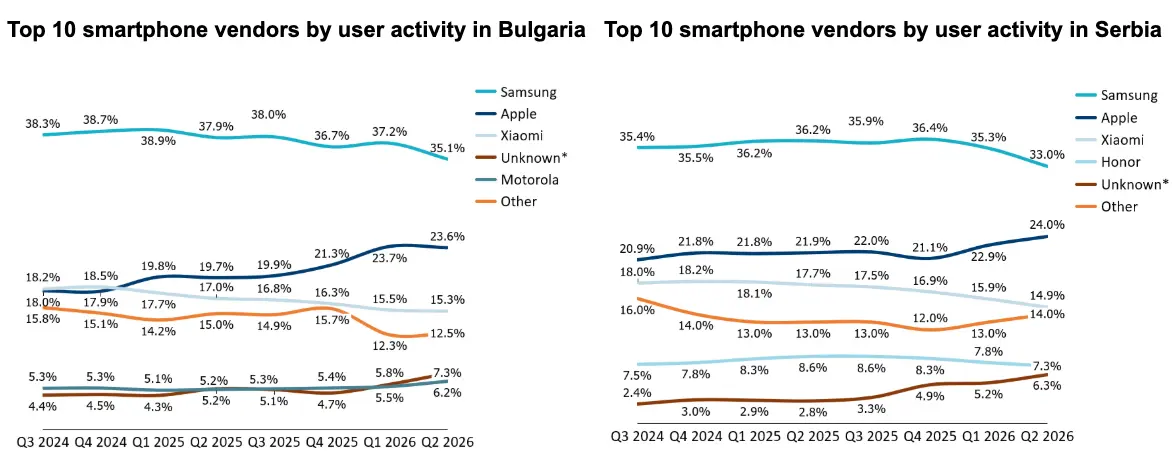
In the largest markets of the macro-region—Bulgaria and Serbia—the TOP 5 vendor structure has remained stable over the past two years. Samsung confidently holds onto its leadership position. Though in recent quarters Apple has been gradually eating into its share. Nevertheless, these changes are minor, suggesting that local users are not particularly sensitive to new model launches. At the same time, a slight increase in the share of unidentified devices has been observed. It may indicate growing consumer interest in Chinese brands.
Eastern Europe comprises three macro-regions. Each with a distinct demand structure—yet global and European trends are introducing new variables. Despite a solid start to 2026 shipments in Europe (+2% in Q1 according to Omdia compared to the same period in 2025), analysts are forecasting a 12% decline in European shipments by year-end.
Counterpoint Research, meanwhile, projects a 13.9% decline in global smartphone shipments. The primary driver: rising component memory prices. This is expected to hit the budget segment and Chinese brands the hardest. Samsung and Apple—backed by stronger financial resources—may well strengthen their positions. For Eastern Europe, a redistribution of market shares is likely on the horizon, requiring OEM advertisers to remain agile and prepared for a new reality.
The smartphone market in Southeast Asia (SEA) is highly diverse. User preferences, market shares, and brand growth rates vary significantly...
Your mobile application can be exceptional. Nevertheless, users won’t discover it if it gets lost deep in the query results....