
The smartphone market in Southeast Asia (SEA) is highly diverse. User preferences, market shares, and brand growth rates vary significantly...

16 June, 2026

OEM traffic in CIS countries is shaped by major smartphone manufacturers, each occupying its own niche across different markets. Understanding which vendors dominate in specific countries helps to more accurately assess the effectiveness of built-in advertising. In this article, we will analyze how OEM traffic is distributed across the CIS region.
The smartphone market in CIS countries is of particular interest from an OEM traffic perspective. It’s driven by several factors:
This is mainly due to regional trade policies and the CIS region’s proximity to major Asian smartphone manufacturers.
In addition, Android devices dominate across CIS countries. Unlike iOS, the ecosystem of most Android devices provides a full-fledged OEM channel for app promotion. According to Statcounter Global Stats, the average share of Android devices in internet traffic across the region reached 72% in 2026 (January–May). In some countries, Android’s share is even higher: 88% in Turkmenistan and 83% in Tajikistan.
Russia is the largest smartphone market in the CIS, which naturally corresponds to having the region’s largest population. In 2025, 24.2 million smartphones were sold in the country. At the same time, the market reflects the global trend of declining smartphone sales. Compared to 2024, when 29.8 million devices were sold, the market contracted by 23%. These figures were reported by distributors F.Plus and M.Video.
However, it is important to note that these figures do not include sales through marketplaces and the gray market. For example, according to the head of the smartphone category at Wildberries & Russ, smartphone sales on the platform nearly doubled in 2025 compared to 2024. Taking these channels into account could significantly improve the overall market outlook.
According to industry experts, the main factors behind the decline in the smartphone market are high inflation and the key interest rate set by the Bank of Russia, both of which directly limit consumer spending.
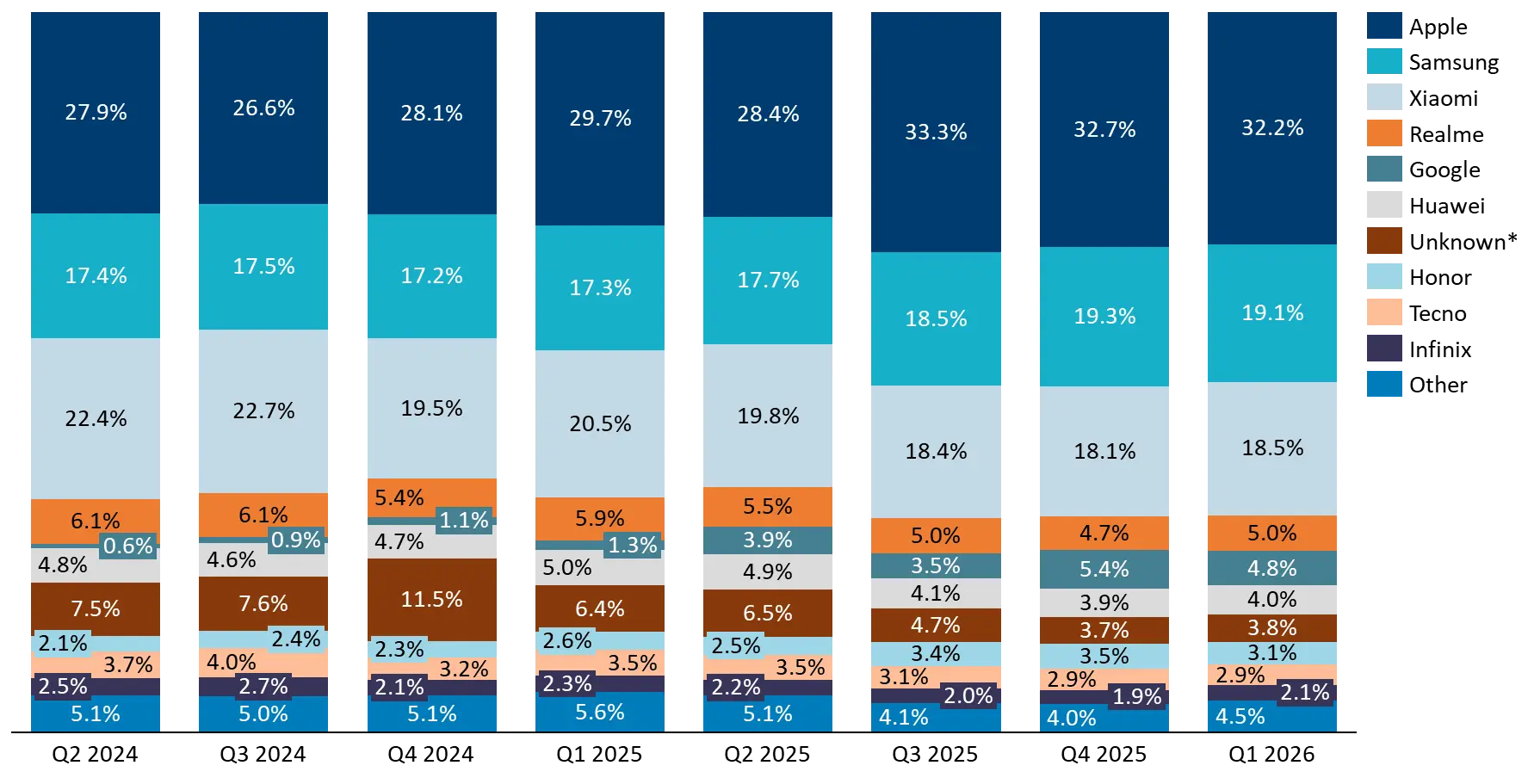
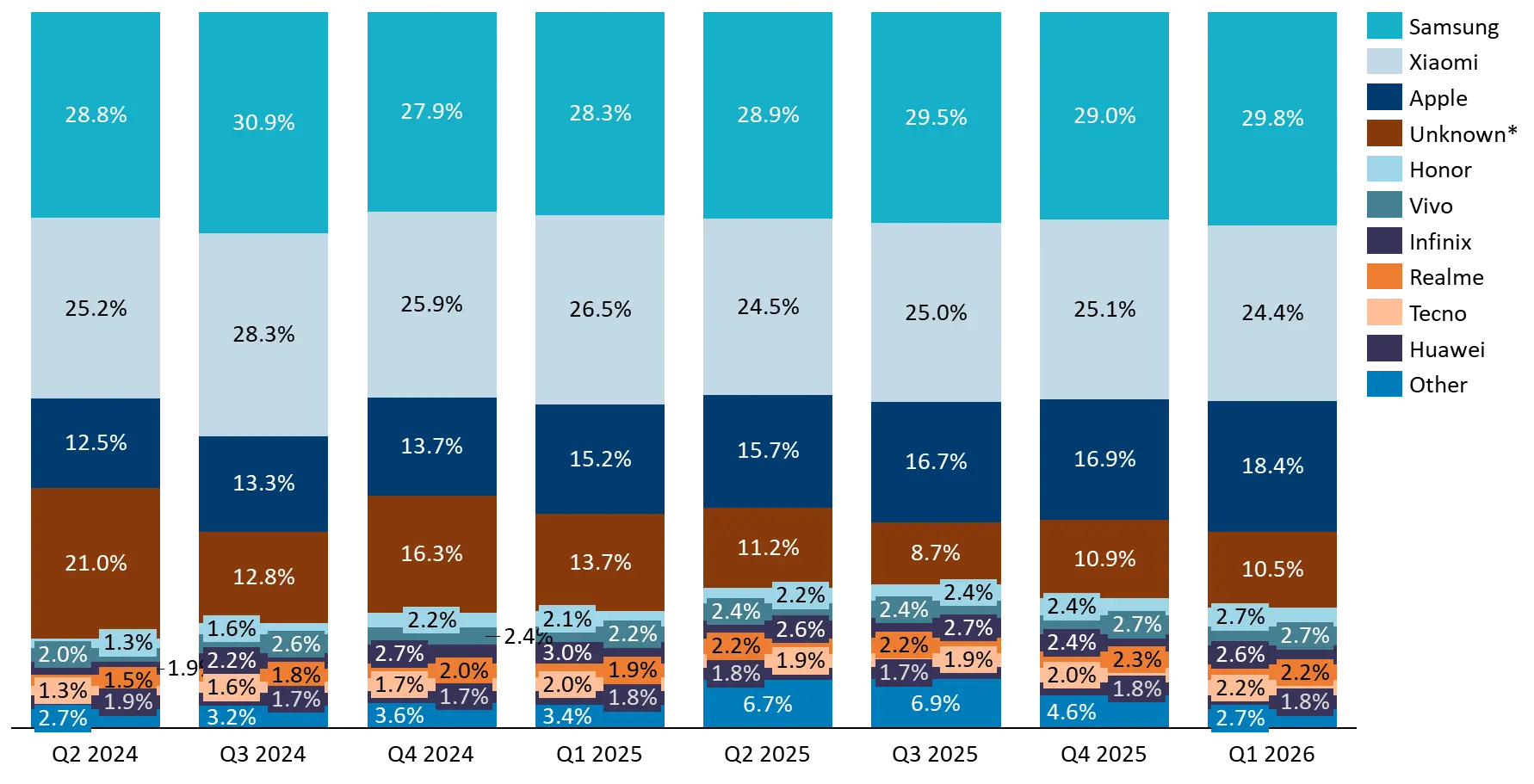
Apple’s share among active users reached 32.2% in the first quarter of 2026. The growth observed in the second half of 2025 and early 2026 was driven by the successful launch of the iPhone 17. It is worth noting that iOS does not support the traditional OEM traffic model for app promotion. Despite Apple’s leading position, Android devices dominate the market. Among them, the combined share of Android models supporting built-in advertising reached 62.4% in the first quarter of 2026.
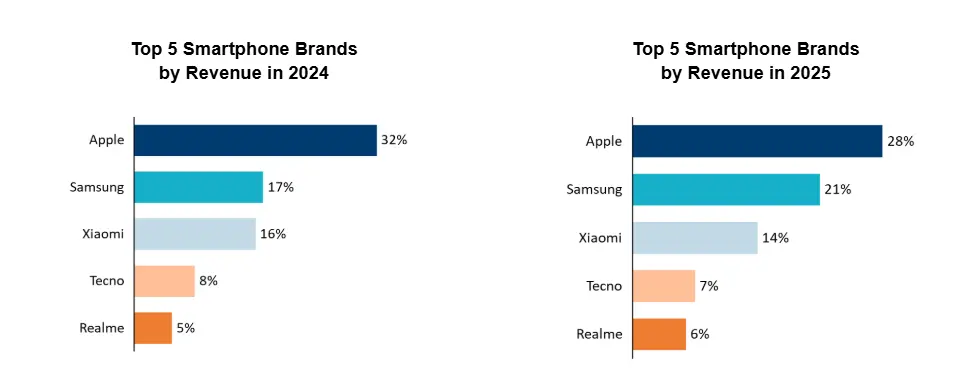
Samsung and Xiaomi also rank among the top three brands by user activity. According to data from MTS, these brands were the best-selling smartphone vendors by unit volume in 2025, accounting for a combined 36% of total sales. However, in terms of revenue, Apple led the market with a 28% share of total smartphone sales.
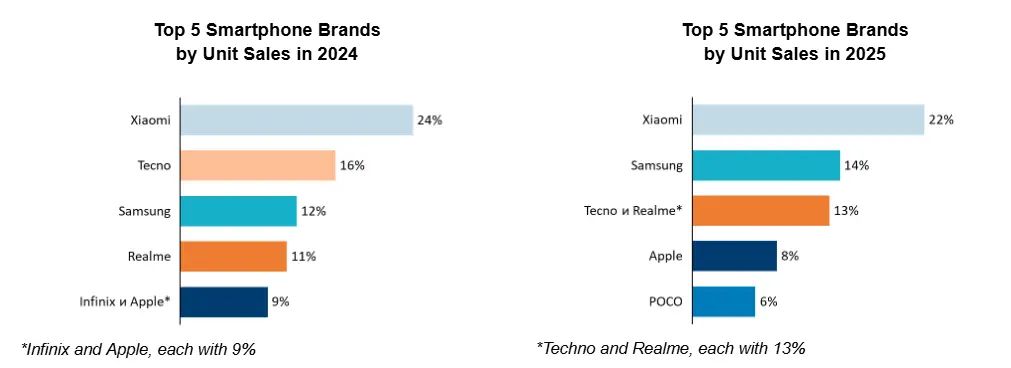
User activity data for Q2 and Q3 2025, as well as Q1 2026, shows an increase in Samsung’s share and a decline in Xiaomi’s share. This trend is confirmed by sales data from MTS. In 2025, Samsung’s unit share increased by 2 percentage points compared to 2024. Xiaomi’s sales share declined by 2 percentage points. Nevertheless, Xiaomi remained the leading brand in terms of unit sales in both 2024 and 2025. However, in terms of user activity, the two brands hold roughly similar positions. This is explained by Samsung devices typically having a longer lifecycle. Xiaomi leads in unit sales due to its lower-priced models and more frequent device replacement cycles.
As for other vendors, Realme’s share slightly declined in recent quarters. Although 2025 sales data shows growth (both in units and revenue) compared to 2024. The popularity of Google devices is increasing in the market, while Huawei has been losing share in recent quarters.
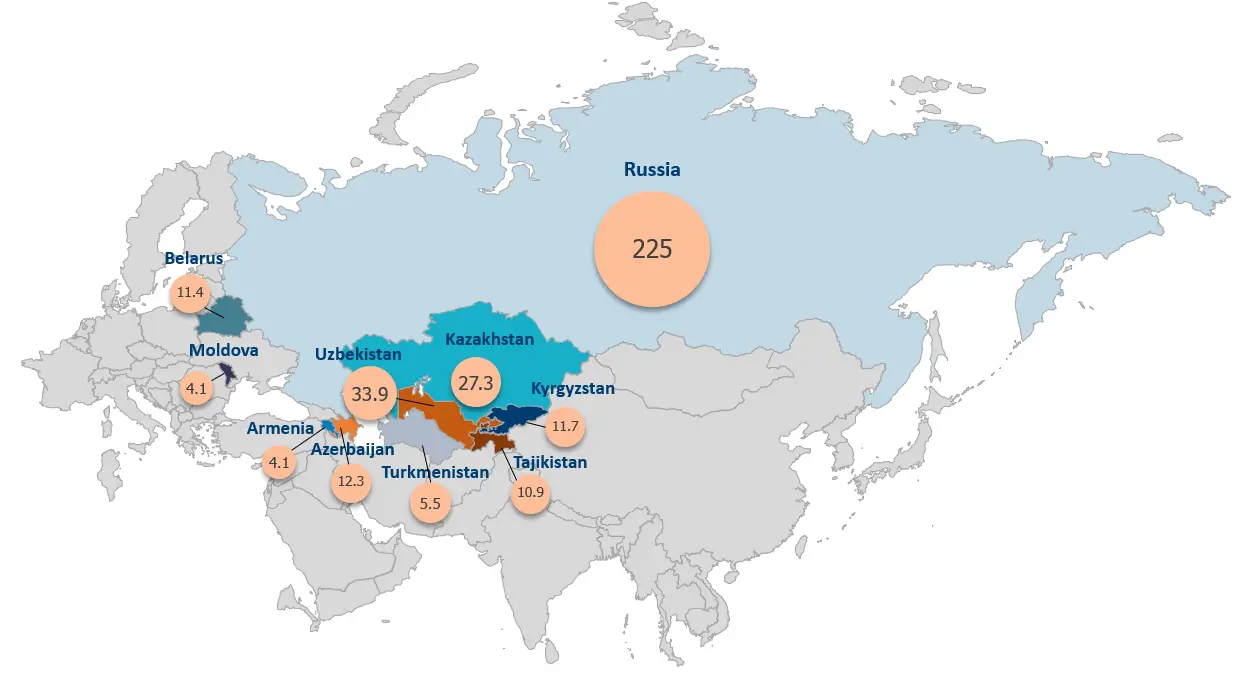
Uzbekistan follows Russia in terms of the number of mobile subscribers in the CIS region. As of the end of 2025, there were 33.9 million mobile subscribers in Uzbekistan. According to GSMA Intelligence, the number of mobile connections increased by 306,000 (+0.9%) compared to 2024.
Most smartphone users (~70%) choose Samsung, Xiaomi, or Apple. However, unlike the global market, Samsung leads in Uzbekistan. In a country with a fast-growing but still price-sensitive economy, affordability and practicality outweigh brand status. Samsung and Xiaomi offer the best price-to-performance ratio, making modern technology accessible to millions.
The share of “unidentified” smartphones in Uzbekistan remains relatively high at 10.5% in Q1 2026. However, recent quarterly data show a declining trend. This suggests that users are increasingly preferring established brands over non-name manufacturers. This dynamic may also be linked to economic growth and improving living standards. The remaining brands in the top 10 each hold only a small share individually (2–3%), indicating a high level of market fragmentation outside the top three players.
Kazakhstan ranks third in the CIS by the number of mobile subscribers. This figure reached 27.3 million as of the end of 2025. Compared to 2024, this represents an increase of 819,000 subscribers, or 3.1%.
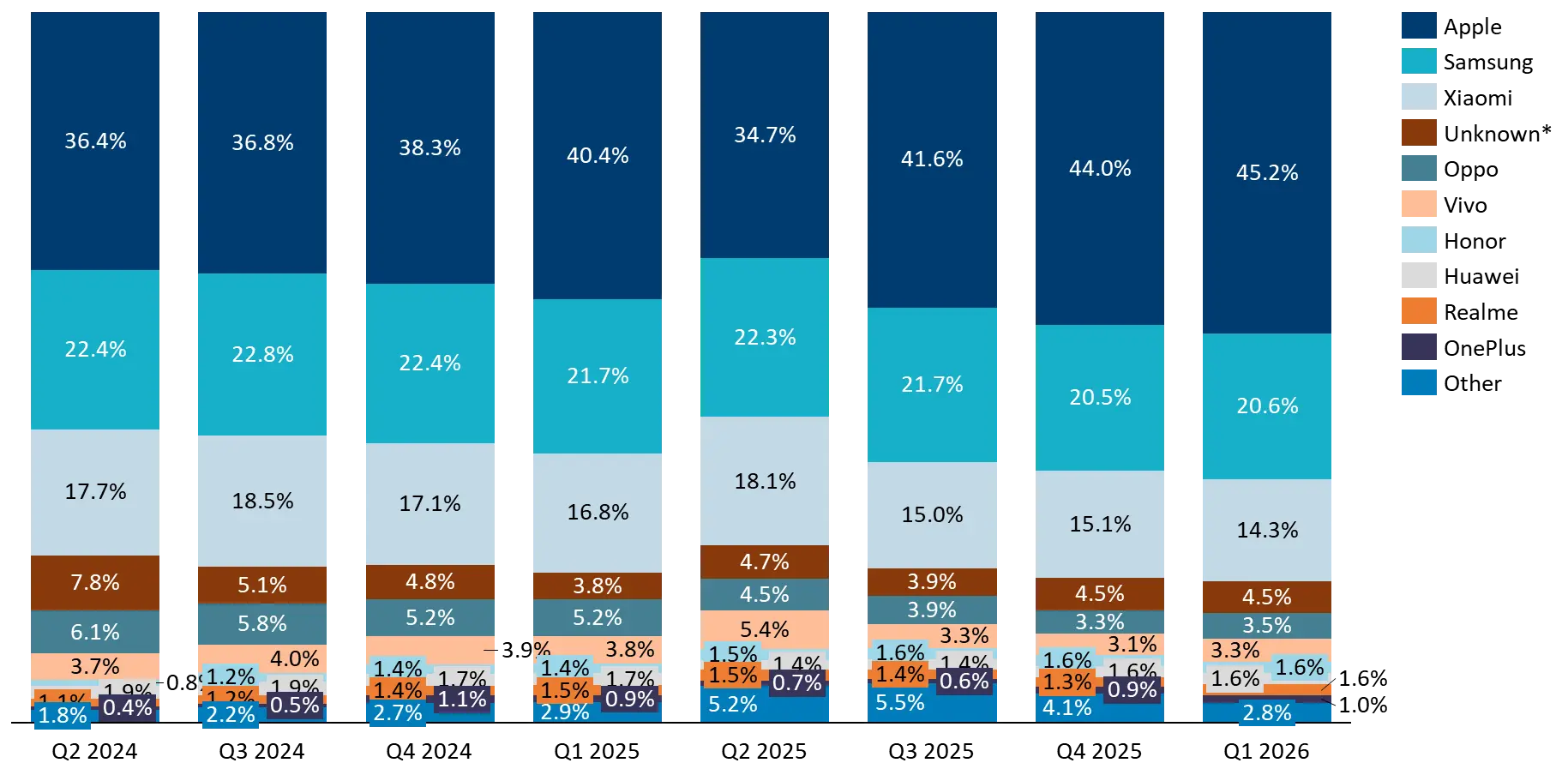
Apple remains the undisputed leader throughout the entire period in Kazakhstan. Its share showed steady growth in the second half of 2025 and in Q1 2026. The top three brands account for nearly the entire audience. In Q1 2026, they collectively represent about 80% of users. At the same time, Samsung and Xiaomi continue to hold strong positions. Apple’s high popularity in Kazakhstan is explained by a combination of factors:
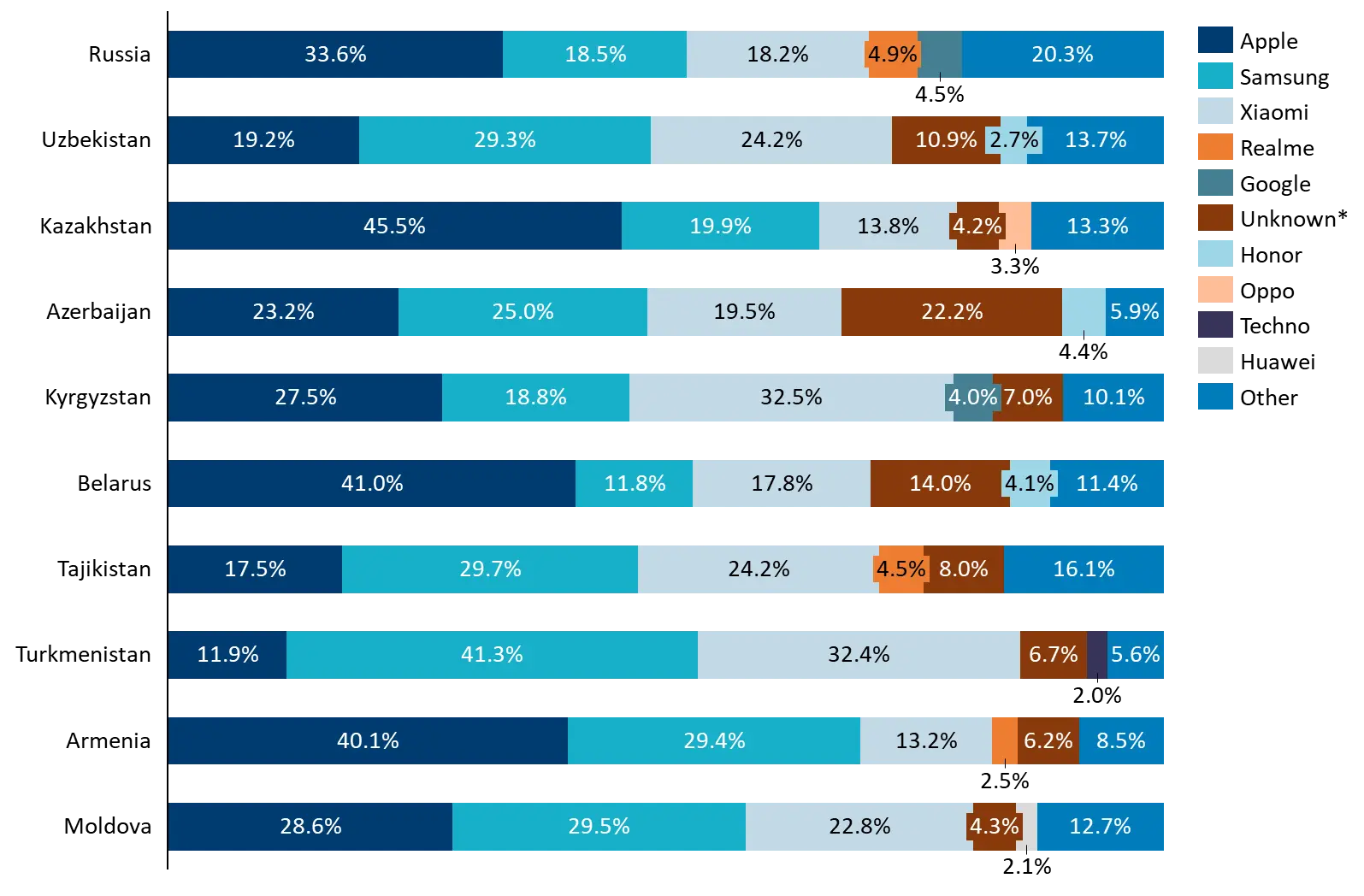
The smartphone market in CIS countries in 2026 shows clear country-level fragmentation. Three types of markets can be identified.
The first type is Apple-dominated. In Kazakhstan, Belarus, and Armenia, the iPhone holds a strong leading position. In Kazakhstan, the gap with the nearest competitor (Samsung, 19.9%) exceeds 25 percentage points. Even in Russia, where Apple’s share is 33.6%, the brand remains the leader.
The second type is Samsung-oriented. Samsung leads in Turkmenistan, Uzbekistan, and Azerbaijan. Turkmenistan is a particularly strong example, where Samsung outperforms Apple by nearly 30 percentage points (41.3% vs. 11.9%).
The third type consists of markets with three-way competition. In Moldova and Kyrgyzstan, three brands (Samsung, Xiaomi, and Apple) share the market with only a few percentage points difference between them. Apple, Samsung, and Xiaomi together account for nearly 81% of the Moldovan market. In Kyrgyzstan, Xiaomi unexpectedly overtakes both Samsung and Apple.
It is also worth noting that Azerbaijan stands out due to an unusually high share of unidentified devices (22.2%). This may indicate a strong presence of budget or counterfeit models, which is important for targeting strategy planning. Realme is visible in Russia and Tajikistan. Google shows a presence in Kyrgyzstan and Russia.
Today, there is no single smartphone market leader across the CIS countries. Apple, Samsung, and Xiaomi divide the region by country, which directly shapes the structure of OEM traffic. In Android-dominant countries, the channel operates at full capacity, while in Apple-dominant markets, OEM reach is more limited. A successful media buying campaign in the region is impossible without country-level adaptation: what works in Kazakhstan is unlikely to work in Turkmenistan. The key focus is on flexibility in adapting to local market structures and selecting the right OEM channel for each country.
The smartphone market in Southeast Asia (SEA) is highly diverse. User preferences, market shares, and brand growth rates vary significantly...

Your mobile application can be exceptional. Nevertheless, users won’t discover it if it gets lost deep in the query results....