

Your mobile application can be exceptional. Nevertheless, users won’t discover it if it gets lost deep in the query results....

23 September, 2026

The ENEA smartphone market varies significantly from country to country. Smartphone brand popularity, device market share, and available OEM channels can differ considerably across the region. In this article, we’ll explore which vendors are present in ENEA markets and the opportunities this creates for advertisers.
*This overview does not cover North Korea, which is part of the ENEA region.
The East and North-East Asia (ENEA) region includes China, Japan, Mongolia, South Korea, and North Korea. One of the region’s key characteristics is China. The country had the largest number of mobile subscribers in the world as of the end of 2025. At the same time, China is the world’s largest smartphone manufacturer, with Android accounting for the majority of devices. Together, these factors make the region highly promising for OEM advertising. Let’s take a closer look at the key trends.
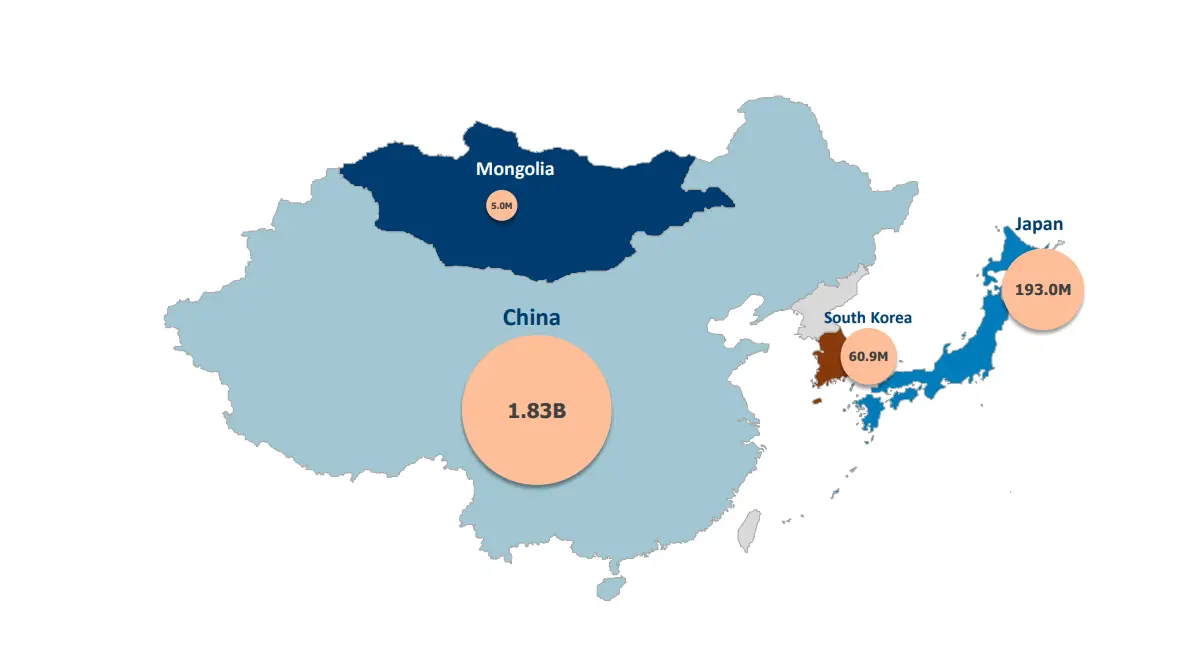
All countries covered in this overview recorded growth in their mobile subscriber base in 2025 compared with the previous year. Japan saw the largest increase: +2.6%, or 4.8 million subscribers. The population declined, suggesting that users are increasingly using multiple mobile devices. The number of mobile connections in Japan equals 157% of the population. In China, the subscriber base grew by 1.7%, or 31 million. The number of mobile connections reached 129% of the population in 2025. The figure increased by 0.3% in South Korea and by 1.5% in Mongolia.
The top five smartphone vendors in ENEA vary significantly across countries in 2026. China has a relatively fragmented smartphone market. Apple leads with a 27.5% share. The Unknown segment is not far behind at 22.1%. This is not surprising, as unidentified devices are primarily manufactured in China. Local manufacturers also hold strong positions in the Chinese market. Huawei, Xiaomi, and Vivo are among the top five vendors. Samsung, which ranks second globally in 2026, does not make the top five in China.
Samsung accounts for 54.1% of users in South Korea, reflecting the strong local brand position. Japan stands out for its high share of Apple users at 61.7%, followed by Google at 10.2%. Japanese preferences are similar to those seen in some Western European countries. In Mongolia, the market picture is closer to the global trend. Apple ranks first, followed by Samsung and then Xiaomi.
Although iOS leads in three out of the four countries, Android’s average share across ENEA stands at 59.2% — more than half of the market.
Over the past year, user activity on Apple devices in China has been increasing. The brand’s share rose from 22.6% in Q3 2025 to 28.6% in Q2 2026, reaching its highest level over the period analyzed. At the same time, the combined share of other brands has been declining since the end of 2025, from 20.2% to 15.8%. The “Other” category includes Oppo, Honor, OnePlus, Samsung, and other brands.
In Q2 2026, the Unknown segment increased by 4.8 percentage points compared with the previous quarter. This increase almost mirrors the 5.4 percentage-point decline in Huawei’s share over the same period. So Huawei devices are being misidentified due to changes in models or identification methods. According to IDC, Huawei smartphone shipments in China increased in Q2 2026 compared with Q2 2025, which indirectly supports this hypothesis.
Overall, smartphone shipments in the Chinese market have been declining for the fifth consecutive quarter. The reason is rising memory component costs and weaker demand. In Q2 2026, shipments fell by 4.3% compared with Q2 2025. Shipments declined for most manufacturers, with only two brands — Apple and Huawei — reporting growth of 19.4% and 24.4%, respectively. According to Counterpoint Research, models from both manufacturers ranked among the TOP 5 best-selling smartphones in China in Q2 2026.
The Japanese market is relatively stable. Apple’s share of users has remained largely unchanged over the past two years. It has ranged between 59% and 62%. Since 2025, there has been growing interest in Google smartphones. The brand’s share increased from 5.7% in Q1 2025 to 11.2% in Q2 2026. At the same time, the share of other brands has been declining, from 22.2% to 15.2%. The “Other” segment includes Sony, Oppo, Vivo, Huawei, and other brands.
Despite a stable market leader, Japan has seen notable shifts within its Android segment. Samsung has strengthened its position, with its share increasing from 5.7% in Q1 2025 to 7.2% in Q2 2026. Xiaomi, by contrast, has been losing users. Its share declined from 6.0% to 4.3% over the same period. The Unknown segment remains low and stable at 5.7–7.0%. This indicates a high level of device identification accuracy in the Japanese market, in contrast to China, where the figure reaches 26%.
The sales structure is consistent with the user activity trends. The TOP 5 best-selling smartphones in Japan in Q2 2026 included three Apple models, the Google Pixel 10a 5G, and the Samsung Galaxy A25 Japan 5G. As a result, Apple accounts for around half of the sales among the TOP 5. The Google model ranks third, in line with the brand’s growing share of user activity.
Around 98% of the South Korean market is accounted for by five players: Samsung, Apple, Google, Xiaomi, and the Unknown segment. At the same time, the combined share of other brands has declined over the past two years, from 2.2% in Q3 2024 to 1.4% in Q2 2026. The share of unidentified devices increased from 2.6% to 11.6% throughout the analyzed period.
Samsung remains the clear market leader. But since the end of 2025, Apple has been actively gaining share. This is likely linked to the successful launch of the iPhone 17. Nevertheless, three of the five best-selling models in Q2 2026 were Samsung smartphones, collectively accounting for 55% of sales among the TOP 5.
Mongolia is a relatively small market in terms of its subscriber base compared with other ENEA countries, with around 5 million subscribers as of the end of 2025. Over the past two years, Apple and Samsung have been competing for the top spot. However, the situation changed noticeably in Q2 2026, when Samsung’s share declined in favor of not only Apple but also Google.
The Unknown segment remains moderate and relatively stable at 4.2–7.6%, indicating an acceptable level of device identification accuracy. Xiaomi, which ranks fourth, is losing users, with its share declining from 9.0% in Q3 2025 to 6.9% in Q2 2026. The “Other” category has remained within the 7.5–8.6% range, with no clear trend.
The ENEA region is a promising market for OEM advertising. But its potential is unevenly distributed. Japan offers data accuracy rather than scale. Its low Unknown share enables reliable targeting. However, Apple accounts for more than 60% of the market in 2026, meaning OEM channels cover less than 40% of users. South Korea, in turn, offers a broad Android inventory. But the growing Unknown segment and Apple’s increasing share are gradually reducing this advantage. China is the region’s largest market and, at the same time, the riskiest. Its high Unknown share and Huawei device identification issues require additional caution. Mongolia is a small but transparent market with a moderate Unknown share.
Overall, Japan and South Korea stand out for data quality and the structure of their Android segments. China, despite its market size, requires caution when assessing actual reach.
Your mobile application can be exceptional. Nevertheless, users won’t discover it if it gets lost deep in the query results....

Concerts, exhibitions, show presentations — today's audiences want more than just watching. They want to immerse themselves and experience vivid...