

Motion graphics have become ubiquitous, appearing in advertising, film, mobile applications, and on websites. They help convey a product or...

11 December, 2025

The technological evolution has brought to the film industry. We have moved from black-and-white films to color ones, and from the green screen to fantastic worlds. As motion capture technology developed, vast possibilities for creating realistic characters have been shown. In the article, we dive into the motion capture technology definition, how it works, and which popular characters have been created with the help of motion capture.
Computer-generated imagery impresses the audience with the grace and expressiveness of digital characters. Viewers witness the magic of technology on screens, where reality and virtuality merge into one, opening up new and fascinating worlds. Motion Capture amplifies the experience, allowing us to feel every emotion of the hero and the rhythm of the movements.
The technology records the movements and facial expressions of actors, allowing each gesture and emotion to be transferred into computer graphics and producing character animation. Motion capture is quite popular in films and video games. Remember the characters from the movie “Avatar” and the popular game “God of War”? CGI artists used motion capture to render living and realistic heroes, and therefore capture the audience’s attention.
As mentioned earlier, the technology reproduces real-life movements mapped onto a digital space. But how exactly are these movements recreated? Motion capture uses cameras, special sensors, and markers to record body motion with the greatest accuracy.
Depending on the goal to be achieved, CGI artists can use different motion capture systems. We have presented several ones in the table below.
| System Type | Areas of Application | Pros | Cons |
| Optical | Film, games, animated movies | Natural character movement, high fidelity | High cost, requires a lot of specialized equipment |
| Mechanical | Virtual simulators/trainers | High data precision/accuracy | Limited freedom of movement |
| Inertial | Augmented/Virtual Reality | Functional, usable in limited spaces | Less accurate/fidelity |
| Hybrid | Games, multimedia | High realism, functionality | High cost/Expensive |
| Depth Sensor-based | Video games, interactive projects | Records motion in three-dimensional space | Lower accuracy, complex setup |
The production process itself is divided into the following stages:
Thus, the 3D character comes to life, performing stunts, jumps, flights, and other movements with maximum realism.
After filming the material, CGI artists begin processing the data and making motion capture animation. Let’s dive deeper into 3 popular software.
Rokoko Vision, based on artificial intelligence, allows you to work for free without any suits. You only need to record several videos where a person makes jumps, tricks, and other manipulations, and then upload them to the program. Rokoko motion capture works with a clear image, so thoroughly check your camera settings before starting the recording.
Autodesk MotionBuilder is a more powerful software used for creating motion capture animation. It provides the necessary tools for pre-visualizing scenes, robust rigging, and a 3D character control system. This program supports all motion capture formats in the production of films and games.
3DS Max supports motion capture technology. Its specialized character animation system, tools for creating crowds, and layer-based animation workflow allow 3DS Max to bring static scenes to life using mocap data.
Curious about the movies made with motion capture? We listed the great ones below.
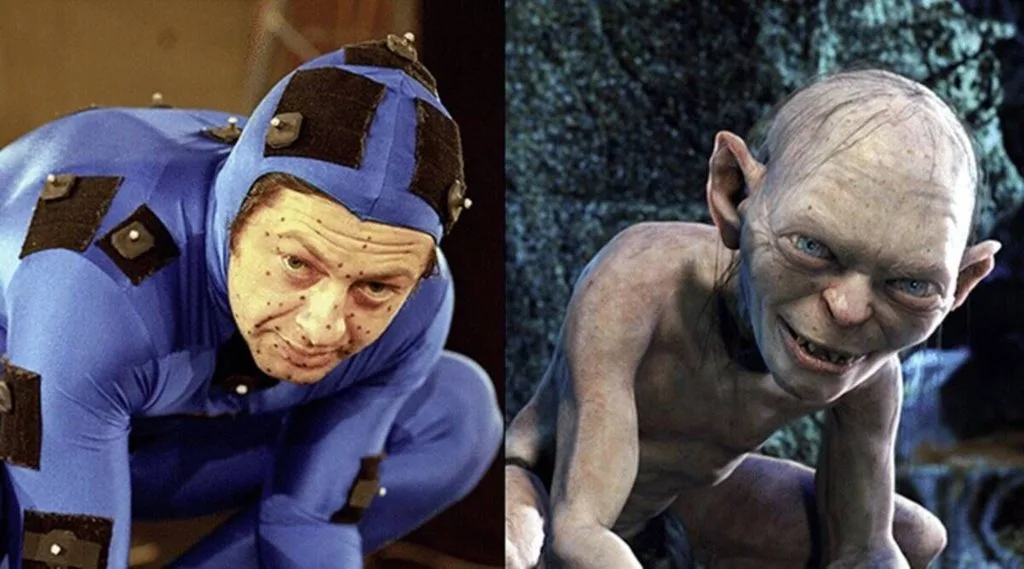
Andy Serkis, who played the role of Gollum, wore a special suit with sensors and markers on set to accurately convey the character’s movements. His character became truly realistic, and thanks to motion capture, it was possible to add emotional instability and expressiveness to the character. Just look at how every wrinkle, the mad gaze, and the malevolent smile are reflected on his face.
James Cameron essentially took motion capture technology to a new level. In addition to special suits, the actors wore head-mounted cameras that recorded their facial expressions. During filming, Cameron could see the digitized characters and the virtual background where the actors were performing. This made it possible to preserve the spontaneity and realism within the fantastical world of the planet Pandora.

Remember Caesar the ape, who transformed from a naive infant into a true leader of his nation? Confidence in his actions was evident in every glance, wrinkle, and movement. Andy Serkis once again excelled in his role. The film’s director followed James Cameron’s example and used an enhanced motion capture technology with sensors and cameras.

Josh Brolin endowed the cosmic tyrant not only with immense physical power but also with convincing charisma and intelligence. Every gesture, head tilt, and facial expression of Thanos was taken from the actor, making the digital villain humanly multifaceted and memorable.

You can discover more about the history of CGI films here.
What to expect in the future? For sure, the technology will be refined. The number of capture points or frame rates will increase. Brands specializing in film graphics should emphasize what matters most: creativity and storytelling.
Our studio creates CGI for film, games, advertising, and show content, tailored to meet our clients’ objectives. Our approach combines a deep understanding of creative goals with technical mastery. We handle complex, long-term projects, guaranteeing deadlines, budget adherence, and the high quality of the final image. Contact us at cgi@acquisition.mobi and let’s craft a visual story your audience won’t forget.
Motion graphics have become ubiquitous, appearing in advertising, film, mobile applications, and on websites. They help convey a product or...

UGC is no longer exclusively “user-generated content.” With the rise of artificial intelligence, marketers are facing a new reality: you...